November 7, 2026

Mountain Goat Trail, rollin’ down the line to Cowan
On Oct. 22 the Cowan Commercial & Community Club met for an expedited “New Trails” Small Business Workshop led by Cowan Railroad Museum president Jarod Pearson, to help business owners, employees, and community partner be eager and ready for the growth we expect from the Mountain Goat Trail extension, an effort Pearson has helped lead throughout the past few years in anticipation of the Mountain Goat Trail extending down the mountain to meet the Cowan Railroad Museum, an exemplary trail head feature for a “Rails to Trails” program. As the gravel is now being placed, the town of Cowan is in an accelerated mode to put resources and plans for development into action for a new welcoming center and accommodations for cyclists and hikers. Pearson emphases, “This is no longer a goal or a vision. This is happening now. All the previous meetings we’ve had, the vision, the goal – we’re past that. It’s coming. There is heavy equipment on the mountain working on the extension to Cowan. The economic and social impact to Cowan is real.”
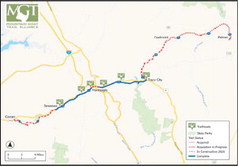
Connecting communities across the mountain from Palmer, through the heart of Tracy City, Monteagle, and Sewanee, to Cowan, Cowan looks to Tracy City for comparison of potential economic impact to a small rural historic Tennessee town. The statistics show that a day traveler will spend an average of $50-60 in town and an overnight traveler, $124 per day in addition to the cost of overnight accommodations. The current average of trail users between Monteagle and Sewanee 220 per day and expected to grow when the downhill ride to Cowan is added. When director of the Mountain Goat Trail Alliance, Patrick Dean, presented the trail to the Cowan Community and Commerce Club two years ago, he described the trail extension to Cowan as the most challenging to engineer…and also the coolest.
Pearson described the seven mile extension to Cowan as the longest, most vital, most expensive and complicated to engineer, also the “most appealing” and a thrill ride: “The best comparison that I can give you is like when you open a new ride at a theme park – this is a thrill ride – a gentle thrill, however people riding their bikes are gonna learn they need their bikes in pretty darn good working condition to ride it” Pearson goes on to explain the appeal to a town becoming a Trail Town, that the Mountain Goat Trail will help galvanize the location situated within a system of some of the finest trails in Tennessee, including Keith Springs, Tims Ford, Sewanee, Crow Creek, the South Cumberland and Fiery Gizzard recreation areas of Grundy County. “We won’t just be a railroad town anymore… trail towns have broader appeal – this is something that’s important for Cowan because [we’ve quietly admitted] being a railroad town doesn’t have broad enough appeal to sustain a town, especially when you can’t come into this town and get on a train. We have a railroad museum, but that’s not enough. We’ll always be a rail town. But becoming a trail town means our identity broadens, our appeal broadens… Every business can and should benefit from this new identity.”
The presentation clued folks in on a history lesson of Cowan’s “60 Year Struggle” – the decline of commerce and the population, beginning with losing its passenger rail service in 1965. Then as the opening of 1-24 diverted traffic away from the 41A/64 intersection, Cowan businesses dwindled further. In the 1980s, Pearson describes as the “biggest kick in the ribs,” Marquette Cement Plant closed, the town’s biggest employer. The population dropped as people moved away to find employment, and those who remained suffered a decrease in household income which is still reflected in today’s Census statistics and poverty rate. In 1997 the town bank relocated. Pearson, having served the last customer on closing day, reflected, “We said that when we lost our bank we would lose our businesses,” and soon B&G Hardware, Myers Pharmacy, Flowerland, Coulson Studio, and Kilby’s Market were gone. By the 2000s Monterey Mills, the next largest employer in Cowan, had closed, and then Shaw industries. 2008 brought the real estate bubble and in 2019 Pearson insists, “You know what happened…” Pearson also highlighted projects which prove community resilience. In 1975 the town pulled together to save the old train depot, create the railroad park, open the Cowan Railroad Museum, and hold the largest Bicentennial celebration in all of Franklin County. In 1982, it was in the grand masterplan to build Clark memorial in Winchester and close the elementary school in Cowan, but the PTO fought to keep it and proved victorious. Cowan businesses started the Cowan Connection publication and the Cowan Commercial Club reactivated, started a new bank task force, and recruited Citizens Tri-County to open in Cowan. The town gained the Monterey Station for large events and Cowan Development Company foreman Mark Ledbetter chaired the committee to pioneer the Fall Heritage Festival, voted “Frankin County’s Finest Event” in 2025.
Yet the struggle continues today for businesses in Cowan with an average of 5,642 vehicles per day passing through town with tunnel vision to see how quickly they can get over the railroad tracks. Blink and you might miss the hotel, restaurants, art gallery, and specialty shops. The Mountain Goat Trail is a remedy to the lack of foot traffic and the challenge of appealing to people to stop in the town of Cowan; however, the prospect of an economic upturn is not the only benefit of the Mountain Goat Trail. It has been the story of cultural revival in “Trail Towns” all throughout Appalachia. As demonstrated in Grundy County, the community focus of resources to recreation, the care and attention to preserving the history and cultural heritage of a small Tennessee town founded alongside the Mountain Goat Railroad.
Mountain Goat Trail update from www.mountaingoattrail.org